Your Skin Type May Not Be Wrong—But It Is Incomplete.
By Kara Ashe · July 24, 2026 · 3 min read
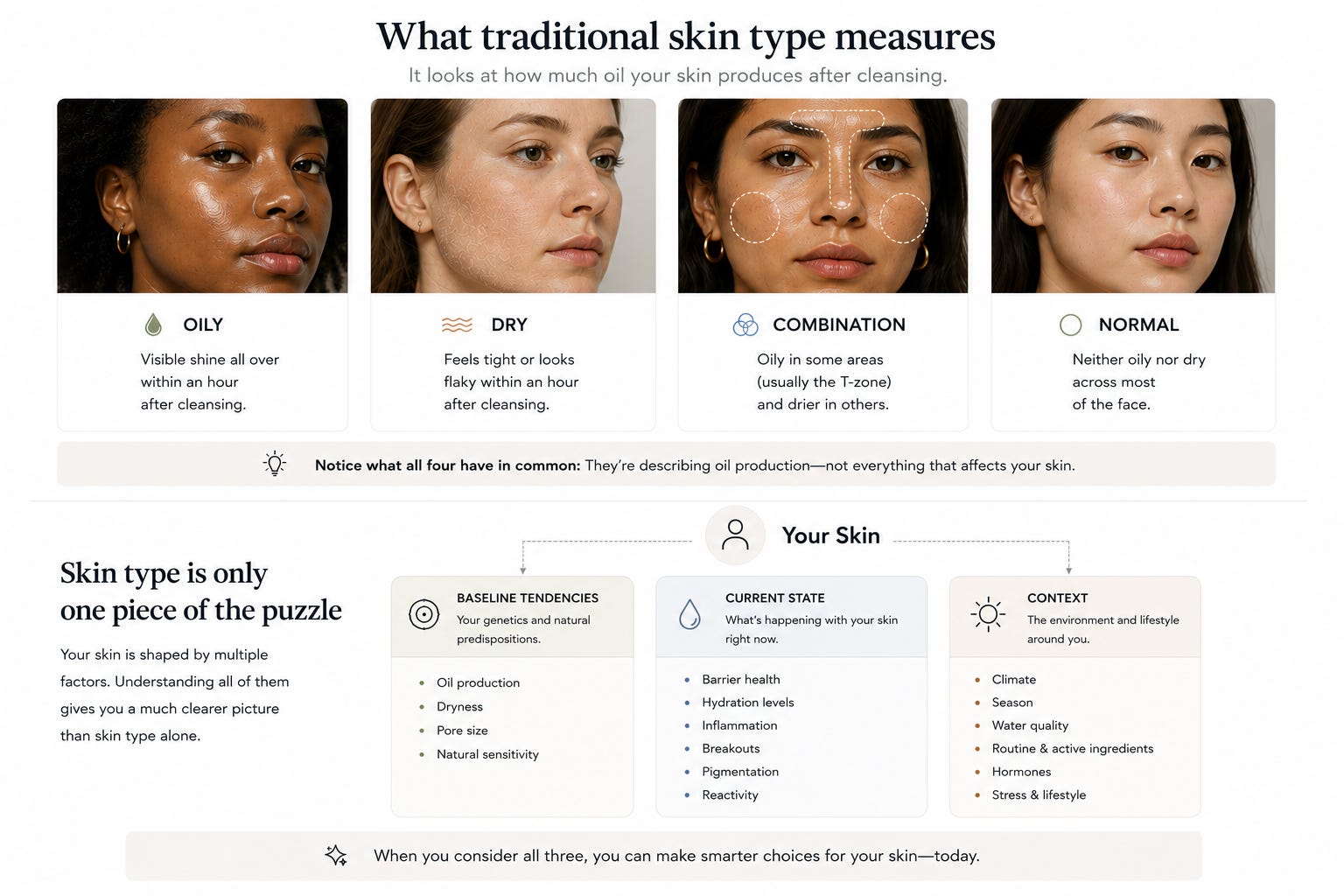
One of the biggest misconceptions in skincare is that your skin can be fully described in a single word: Oily. Dry. Combination. Normal.
Those categories aren’t wrong, but they were never designed to explain the totality of your skin. And their simplicity creates real blindspots – aka, they can’t tell you why the same product works beautifully for your friend and breaks you out within 48 hours.
We’ve all done it. A friend – or a favorite influencer – has incredible skin.
You know you both have “combination skin,” so you buy the same serum they’re raving about, because surely what works for them should work for you too. 48 hours later you’re breaking out and wondering what went wrong.
We’ve been so conditioned to think in terms of “skin types,” because it ultimately simplifies how we understand our skin. But as with most things, a simplified understanding does not equate to a complete one. That said, skin types aren’t useless. The problem is that they describe one dimension of your skin—not all of it.
Think about what skin-typing actually tells you: If your skin looks slick and shiny after cleansing – and before you’ve applied any products – you’re considered oily. If it feels tight or looks flaky, you’re likely dry. If your skin looks like some blend of the two across different spots, your skin is probably combination. Take a guess what it means when your skin looks pretty normal across the board.
Those categorizations have served as memorable, pocketable guidance since the 1940s, becoming one of the primary ways consumers were encouraged to choose skincare by the 1970s. Skin typing became popular because it solved a real problem: it gave people a simple way to choose products based on visible skin behavior. That simplicity made it incredibly useful, but it also meant it couldn’t capture everything we now know about how skin behaves.
Since the 90s, researchers, dermatologists, and the skincare industry started paying much closer attention to barrier function, inflammation, pigmentation, UV damage, and skin reactivity, along with factors like hormones, genetics, environment, and climate. It all influences how skin behaves and responds to skincare.
As you may have gathered by now, we need to reframe our thinking. It’s not “What is my definitive skin type?” Rather, the question is, “what is the prevailing state of my skin?” Is it producing a lot of oil, looking and feeling slick? Is it currently flaking, tight, or generally dehydrated, but breaking out? Is it tight and flaky in some spots but slick in others? There’s yet another layer here, though: your skin doesn’t exist in a vacuum. It responds to context.
Once we understand our skin’s baseline tendencies, we then need to think about the environment we’re in and how it impacts our skin. It’s July, and I now live in the Mid-Atlantic, where it’s hot and humid. My combination skin – which has been erring slightly drier in recent years – feels quite comfortable and appears overall more dewy thanks to the extra moisture. I’m also no longer dealing with the same “hard water” I’d lived in in LA. So we have geography, seasonality, weather, biological changes, and water, all impacting the state of my skin. That’s a bit more complex than “combination skin.” And that’s all before we talk about how reactive my skin is generally, or sensitivity I may have caused with my routine.
I’m not suggesting you toss the baby with the bathwater – you need a baseline understanding of your skin’s natural state. There’s just more to consider at any given moment before choosing the next product you introduce to your face. Understanding your skin’s baseline tendencies, its current state, and the context it’s living in will almost always tell you more than skin type alone ever could.
Does that take a little more effort? Yes, a little more. But is it worth it to understand your skin? Absolutely.